What Vinaigrette Teaches You About Trusting Your Palate
Part of the Emulsions series at Loire Kitchen

There is a particular memory that comes back to me whenever I make a vinaigrette.
I am sitting in a diner somewhere in the American Midwest — I can’t remember which state, which town, which year — and a salad arrives. The leaves are buried. Not dressed. Buried. A lake of thick, pale, pre-made Ranch dressing has settled across them like a flood, obliterating everything underneath. The tomatoes have surrendered. The lettuce’s white flag has already drowned.
I ate it. Of course I ate it. But I longed, with a peculiar intensity, for a salad I had eaten the week before somewhere in France — a simple frisée, barely coated, sharp enough to make your eyes water slightly, with something underneath it all that tasted unmistakably of the place.
That contrast — between a dressing that masks and a dressing that enhances — is what vinaigrette is really about. And it is, I’ve come to believe, one of the most useful things you can learn in a kitchen.
The Leaves Are the Point
A salad dressing exists to serve the leaves, not to replace them.
This sounds obvious. It isn’t, apparently — not everywhere. In the UK and the United States in particular, the habit of pre-made dressings in industrial quantities has trained a generation of eaters to expect something thick, sweet, and heavily seasoned, applied with a generous hand. Ranch. Blue cheese. A bottled “French” or “Italian” that bears no resemblance to anything made in France or Italy.
In France and Italy, the dressing is almost an afterthought — and that is entirely the point. A good vinaigrette should barely coat the leaves. It should sharpen them, season them, bring them alive. The moment it begins to pool at the bottom of the bowl, something has gone wrong.
Good leaves matter too. A single variety — a frisée, an oak leaf, a butter lettuce — can carry a meal on its own if dressed correctly. A mixture of leaves with a few leafy herbs added in small quantities does the same. What they cannot do is survive a swimming pool of dressing.
The Formula — and Why It’s Only the Beginning
The classic formula for vinaigrette is one part acid to three parts oil. It is a useful starting point and an unreliable rule.
The reason is simple: not all acids are equal. A young white wine vinegar is sharp and clean. Cider vinegar has a softer, more rounded quality. An aged sherry vinegar carries a depth and sweetness that means you need far less of it. Lemon juice behaves differently again — brighter, more volatile, more alive on the palate. And the same vinegar from a different producer, a different year, a different bottle, can vary significantly.
The age and condition of the vinegar matters too. Red wine vinegar in particular sharpens and intensifies as it gets older once opened. I once had to send back a salad in a French restaurant because the vinegar in the dressing tasted of nail polish remover — oxidised, acetic, unpleasant. It had almost certainly been sitting open on a shelf for too long. Store all vinegars in a cool, dark place, and always smell and taste before use. A vinegar that has turned will ruin a dressing before you’ve added a drop of oil.
Which means the formula is a compass, not a map. One part acid to three — or sometimes four — parts oil gets you close. Your palate gets you the rest of the way. The only reliable instruction is: taste, taste and taste again.
This is, I think, one of the most liberating things vinaigrette can teach you. Because once you understand that the recipe is an approximation and your judgement is the real instrument, you begin to cook differently. You stop following and start tasting. And that shift — from instruction to understanding — is what cooking actually is.
The Boiling Water
Here is the step that surprises almost everyone.
Two teaspoons of boiling water, added to the bowl after the vinegar and mustard, before any oil goes in.
Most recipes don’t mention it. The ones that do rarely explain it. But it is the step that makes the difference between a dressing that coats and one that slips, between a vinaigrette that holds together and one that separates the moment it hits the leaves.
Water is a natural emulsifier. In the context of a vinaigrette — which is, technically, an unstable emulsion of oil in a water-based liquid — the addition of a small amount of hot water helps the dressing come together more cohesively, gives it a lighter texture, and helps it cling to the leaves rather than pool beneath them.
This is the same principle at work in mayonnaise, where a teaspoon of boiling water at the end stabilises the emulsion and silkens the texture. The medium is different, the scale is different, but the underlying logic is the same. Water is doing real work — and once you know it, you’ll never leave it out.
Making It Wrong on Purpose
There is one more counter-intuitive instruction that I give every group that makes vinaigrette with me.
Make it sharper than you want it.
Not dramatically sharper. But the dressing you taste in the bowl should have a little more acidity than you would want on the plate — because the moment it touches the salad leaves, something happens. The leaves absorb some of the acid. They soften it, round it, neutralise a fraction of the sharpness. A dressing that tastes perfectly balanced in the bowl will taste flat and oily once tossed.
This is the kind of thing that no recipe can tell you in advance, because every batch of leaves is different and every dressing is different. What it requires is attention — an understanding of how ingredients interact with each other, not just how they taste in isolation. It is, in miniature, a lesson in how cooking actually works.
A Dressing Worth Reverse-Engineering
The fourth dressing in this collection has a different origin from the other three.
My husband and I had an evening at ‘t Hofke — a magical bistro hidden in the oldest alley of Antwerp, down a courtyard near the Cathedral. It is a beautiful, romantic setting, the kind of place that feels unchanged by time in exactly the right way.
The salad arrived dressed in something I couldn’t immediately identify. No olive oil. No vinegar as such. Something sweet, something sharp, something creamy — and underneath it all, the unmistakable flavour of raspberry.
I dissected it at the table. The waiter, to his credit, looked only mildly alarmed. By the time we left I had a reasonable working theory, and by the following week I had a version I was happy with: raspberry vinegar, honey, yoghurt, water. No oil at all.
It is the most unusual dressing in this collection and, for the right salad, possibly the best. Particularly good with delicate leaves, fresh fruit, and anything involving avocado.
The lesson it carries is a simple one. The best recipes don’t always come from books. Sometimes they come from a meal in a courtyard in Antwerp, and a waiter who was too polite to ask what on earth you were doing.
What Vinaigrette Is Really About
I’ve made vinaigrette hundreds of times, in every variation, in every season, with guests from across Europe, North America and beyond.
The version that stays with people is rarely the most technically accomplished one. It is the one where they stopped measuring and started tasting. Where they added the water and felt the dressing change. Where they made it too sharp on purpose and found, to their surprise, that it was right.
A vinaigrette is a small thing. It takes three minutes to make. It requires no special equipment, no unusual ingredients, no particular skill. And yet, done properly, it demonstrates almost everything that matters in a kitchen: seasoning, balance, emulsification, the relationship between acid and fat, and above all, the primacy of taste over instruction.
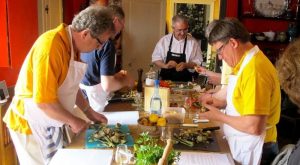
That is what I try to teach at Loire Kitchen. Not recipes. Understanding.
—
*The full recipe — Classic French Vinaigrette, Italian, Fresh Berry and ‘t Hofke — is here. If this is the kind of cooking you’re looking for — hands-on, unhurried, and rooted in real technique — take a look at our [culinary holidays in the Loire Valley](https://www.loirekitchen.com/culinary-holidays/). Small groups, market-led menus, and a kitchen where nothing goes to waste.*