What Mayonnaise Teaches You About Cooking Confidently
Part of the Emulsions series at Loire Kitchen
Last Updated on 5th April 2026 by Aaron Tighe
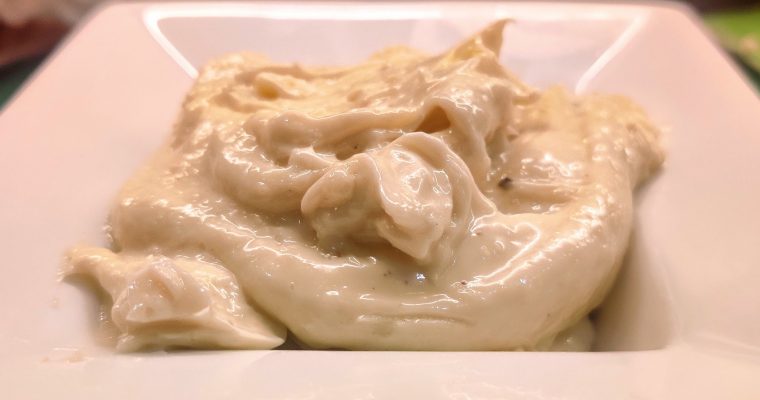
There is a moment that happens in my kitchen, usually about ten to twelve minutes into making mayonnaise, when something shifts.
Not in the bowl. In the room.
Someone in the group will notice the mixture beginning to look a little loose, a little oily around the edges. They’ll glance up. There’s a hint of uncertainty — that familiar feeling that something is about to go wrong, and that it will somehow be their fault.
That moment is, quietly, one of the most important things I teach.
But before we get to that, a story.
The best tip I ever received about mayonnaise came from Fanny and Johnnie Cradock — the formidable British television cooks who dominated the nation’s kitchens in the 1950s and 60s. In their book A Cook’s Essential Alphabet, now long out of print, Johnnie describes an occasion when Fanny left the mixer beating egg yolks and went to answer the phone. The call was an important one. She forgot about the eggs entirely and returned to find a thick, almost white batter in the bowl. Hoping for the best, and unwilling to waste the eggs — Fanny’s generation had lived through rationing, and waste was not something they took lightly — she began to add the oil. The emulsion held so firmly that she simply kept pouring. The result: perfect mayonnaise.
The lesson — that thoroughly beaten egg yolks make a far more stable emulsion — has stayed with me ever since. And it shaped the way I teach mayonnaise to every group that comes through my kitchen.
Before You Begin — Temperature is Everything
Mayonnaise is an emulsion — a stable suspension of oil in water, held together by lecithin, the emulsifying agent found in egg yolk.
Lecithin works best at room temperature. When it’s cold, it becomes sluggish. The fats in a cold egg yolk are close to solid, and the whole process becomes an uphill battle before you’ve even started.
Mustard — I mostly use Dijon — plays a dual role that most recipes never bother to explain. Yes, it adds flavour. But it also contains lecithin, making it a second emulsifying agent working alongside the egg yolk. This is why mustard is in the recipe, not merely in the tradition. It is doing functional work.
Which means that cold mustard straight from the fridge isn’t just a temperature problem — it’s a split waiting to happen. Take it out alongside your eggs. And a word on seasoning: salt and pepper must go in before any oil is added. Just as in a vinaigrette, seasoning will not dissolve once the oil is present. Everything in the bowl should be at the same temperature and properly seasoned before a drop of oil is added. This single habit will transform your success rate.
Why Do Some Countries Refrigerate Eggs?
If you’re from the United States, Canada, Australia, Japan, or Scandinavia, your eggs almost certainly come from the fridge. In the UK and most of continental Europe, they sit on the counter — and with good reason.
Hens’ eggs have a natural protective coating called the bloom (or cuticle) — a thin, antibacterial layer that seals the porous shell and protects the egg from bacterial penetration. In countries where eggs are commercially washed before sale, this coating is removed. Once gone, refrigeration becomes necessary to slow bacterial growth on the now-exposed shell.
European regulations take the opposite approach: washing is prohibited precisely to preserve the bloom, which means eggs can safely be stored at room temperature. That said, even uncoated eggs stay fresher for longer when refrigerated — so if you do keep them in the fridge, simply remember to take them out well ahead of time.
For mayonnaise-making, the practical consequence is simple: if your eggs have been refrigerated, take them out at least an hour before you begin. Cold lecithin is inefficient lecithin — and an emulsion that starts cold is already at a disadvantage.
Choosing Your Oil
The oil you choose shapes the character of the mayonnaise entirely, so it’s worth thinking about before you start.
For a classic, neutral mayonnaise — the kind that works with everything — I reach for sunflower, safflower, or grapeseed oil. They are clean, light, and let the egg and seasoning speak. Avocado oil and canola work well too, as does a light olive oil if you want just a whisper of something rounder.
Standard olive oil is a different matter. It has personality, and in mayonnaise that personality can become overwhelming — bitter, heavy, insistent. But pair it with garlic and suddenly everything changes. Aioli — that fierce, golden, garlicky emulsion I associate with seafood and hot Spanish summers — demands olive oil. The strength of the garlic and the character of the oil are made for each other. Neither would be improved by compromise.
The same logic applies to rouille, the saffron and pepper-spiked mayonnaise that sits atop a proper bouillabaisse. Olive oil belongs there too.
And then there is my own version — made with malt vinegar instead of the more usual white wine vinegar or lemon juice. It gives the mayonnaise a distinctly British quality: a little deeper, a little more robust. It is, I’ve discovered, almost unreasonably good with French fries. A French technique, a British ingredient, and the most universally loved food on earth. Some combinations simply work.
The full recipe — Classic Mayonnaise, Aioli, Rouille and Malt Vinegar — is here.
When Things Go Wrong — and They Will
Back to that moment in the kitchen.
The mixture has split. The oil has refused to bind. What was beginning to look like mayonnaise now looks like an oily, curdled disappointment.
Here is what I tell my guests: this is not a disaster. This is the lesson.
Eight times out of ten, a single teaspoon of boiling water, beaten into the split mixture, will bring it back. The heat relaxes the proteins, the water gives the lecithin something to work with, and the emulsion — slowly, then suddenly — comes back together. It is one of those small kitchen rescues that feels disproportionately satisfying.
It’s worth knowing that hot water plays a dual role in mayonnaise. Added at the end of a successful emulsion, it stabilises and silkens the mixture — a finishing step worth doing regardless. Added to a split emulsion, it can rescue it. The same ingredient, two different jobs. Understanding why something works always gives you more than one way to use it.
And on the occasions when even that doesn’t work? We take the split mixture and incorporate it, slowly, into a freshly beaten egg yolk. Nothing is wasted. There is almost always a way back.
I’ll admit that I don’t always wait for mayonnaise to split naturally. If I’ve forgotten to take the mustard out of the fridge — which happens — I know what’s coming, and I let it. Because the rescue is worth more than the perfect result. Watching someone bring a broken emulsion back together, with their own hands, in real time — that’s confidence being built. That’s the thing they’ll carry home.
What Mayonnaise Is Really About
I’ve made mayonnaise hundreds of times, in every variation, with guests from across Europe, North America, and beyond. And the version that stays with people is rarely the most technically perfect one.
It’s the one that split. And came back.
The kitchen is an honest place. Things go wrong. Ingredients resist. Timing slips. What matters is knowing that most mistakes are recoverable, that understanding why something failed is more valuable than pretending it didn’t, and that the confidence to keep going — to add a teaspoon of hot water and trust the process — is something that can be learned.
That’s what I try to teach at Loire Kitchen. Not perfection. Quiet confidence.
If this is the kind of cooking you’re looking for — hands-on, unhurried, and rooted in real technique — take a look at our culinary holidays in the Loire Valley. Small groups, market-led menus, and a kitchen where nothing goes to waste.